Disclaimer
This article is for general informational purposes only. It summarizes publicly available FDA/EPA guidance and peer-reviewed research. For individual health decisions -- especially during pregnancy, nursing, or for children with specific health conditions -- consult your physician or pediatrician and follow local fish consumption advisories issued by your state or territory.
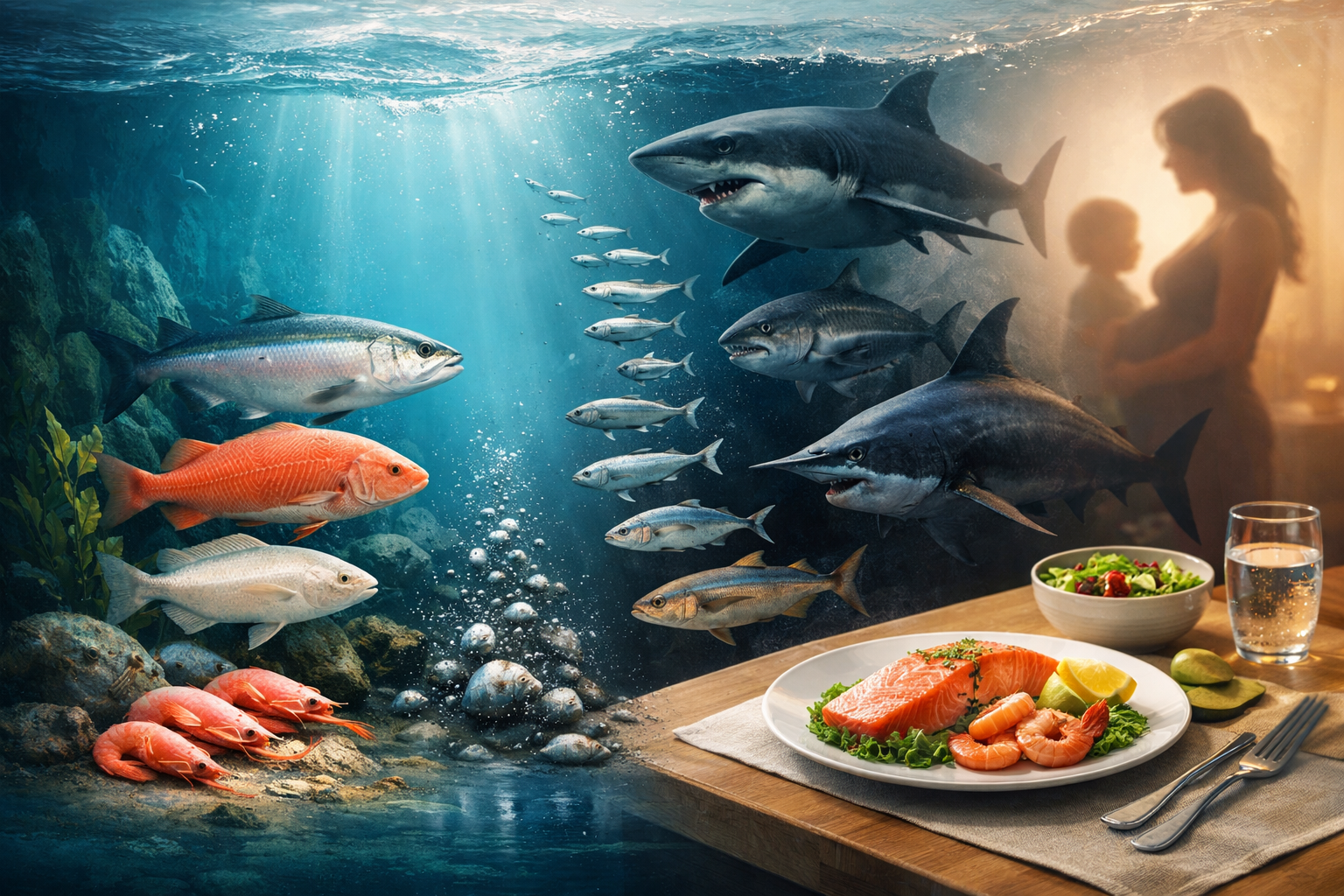
When it comes to fish during pregnancy and childhood nutrition, the conversation tends to swing between two extremes: "fish is incredibly beneficial" or "mercury -- stay away." The right approach is neither. Fish remains one of the most nutrient-dense foods available, delivering high-quality protein, omega-3 fatty acids critical for fetal brain development, iodine, selenium, vitamin D, and B12. At the same time, methylmercury is a real contaminant that accumulates in certain species and can harm developing nervous systems at high exposures.
The good news? The FDA and EPA's official guidance tells us we do not have to choose between benefit and safety. We can manage the risk through species selection. The system is straightforward: pick from the right list, follow the portion guidance, and you get the nutritional benefits of seafood while keeping mercury exposure well below any level of concern.
Let me walk you through exactly how this works.
What Is Mercury and Why Does It Matter?
Mercury enters the environment primarily through industrial emissions -- coal-burning power plants, mining operations, and certain manufacturing processes release elemental mercury into the atmosphere. Once it settles into waterways, bacteria in aquatic sediments convert it into methylmercury, an organic form that is far more efficiently absorbed by living organisms than inorganic mercury.
Here is where the biology matters. Methylmercury binds tightly to proteins in muscle tissue. When a small fish absorbs methylmercury from water or sediment, it accumulates in its flesh. When a larger fish eats that smaller fish, it absorbs the smaller fish's mercury load on top of its own. This process -- called bioaccumulation and biomagnification -- means that mercury concentrations increase dramatically as you move up the food chain. Predatory species can have body concentrations up to 10 times higher than the species they consume.
The practical consequence is intuitive once you understand the mechanism: larger, older, and more predatory fish accumulate the most mercury. A swordfish that has spent 15 years at the top of the oceanic food chain will carry mercury concentrations hundreds of times higher than the sardines it feeds on. A farmed tilapia that eats plant-based feed will have almost none.
For adults, moderate methylmercury exposure from normal fish consumption is not considered a significant health risk -- the body eliminates it with a half-life of approximately 70-80 days, and the cardiovascular and nutritional benefits of fish consumption outweigh the mercury risk at normal intake levels. However, for developing nervous systems -- in fetuses, infants, and young children -- methylmercury poses a more meaningful concern. It crosses the placental barrier, it concentrates in breast milk, and the developing brain is more vulnerable to its neurotoxic effects. This is why specific guidance exists for pregnant women, nursing mothers, and children.
Best / Good / Avoid: Understanding the FDA/EPA Chart
In 2017, the FDA and EPA jointly released their "Advice About Eating Fish" framework, last updated in October 2021. Rather than giving a single blanket recommendation, they classified commercially available fish and shellfish into three categories based on measured mercury concentrations across thousands of samples:
The FDA/EPA Three-Tier Classification
Best Choices (lowest mercury, ≤ 0.15 ppm): You can safely eat 2-3 servings per week from this list.
Good Choices (moderate mercury, 0.15-0.46 ppm): Limit to 1 serving per week, and do not eat any other fish that week.
Choices to Avoid (highest mercury, > 0.46 ppm): Pregnant women, nursing mothers, and children should not eat these at all.
This system is elegant in its simplicity. You do not need to memorize mercury concentrations in parts per million. You do not need a calculator. You just need to know which list your fish falls on and follow the portion guidance. The entire framework is built on the principle that you should eat fish -- just the right kinds.
Weekly Portion Guide
Knowing which species to choose is only half the picture. The other half is how much and how often. The FDA/EPA guidance provides clear portion recommendations that differ by population group.
Pregnant and Nursing Women
One serving equals 4 oz (~113 g) of cooked fish -- roughly the size of the palm of your hand. The recommendations are:
- Best Choices: Eat 2-3 servings per week (8-12 oz / 227-340 g total)
- Good Choices: Eat 1 serving per week (4 oz / 113 g), and do not eat any other fish that week
- Choices to Avoid: Do not eat these species
Children (Ages 1-11)
Children should eat 2 servings per week from the Best Choices list. The key difference is the serving size, which scales with age:
Age-Based Serving Sizes for Children
Ages 1-3: 1 oz (~28 g) per serving
Ages 4-7: 2 oz (~57 g) per serving
Ages 8-10: 3 oz (~85 g) per serving
Age 11: 4 oz (~113 g) per serving
Children 12 and older can follow the adult serving guidelines (4 oz per serving, 2-3 servings/week from Best Choices).
These smaller portions reflect children's lower body weight and the corresponding lower threshold for methylmercury exposure.
A Note on Locally Caught Fish
The FDA/EPA guidance applies to commercially sold fish. If you eat fish caught by family or friends from local waters, check your state or local fish advisory. Many states issue specific advisories for rivers, lakes, and coastal areas based on local contamination levels -- which can include not only mercury but also PCBs, dioxins, and other industrial pollutants. If no advisory is available for your local waterway, the FDA recommends eating only 1 serving of that fish per week and no other fish that week.
Common Species by Category
Here is a practical reference list of commonly available species, organized by the FDA/EPA classification.
Best Choices (2-3 servings/week)
Anchovy -- Very low mercury, excellent omega-3 source. Fresh, canned, or as paste.
Sardine -- Among the lowest mercury of any fish. Outstanding omega-3, calcium (when eaten with bones), and vitamin D.
Salmon -- The go-to recommendation. Low mercury, high omega-3 (both wild and farmed). Atlantic, sockeye, coho, pink -- all qualify.
Atlantic mackerel -- Low mercury, rich in omega-3. Note: Do not confuse with king mackerel, which is in the Avoid category.
Shrimp -- Very low mercury. Mild flavor makes it versatile and kid-friendly.
Tilapia -- Very low mercury. Modest omega-3 but excellent lean protein source.
Canned light tuna -- Typically skipjack tuna, smaller and shorter-lived than other tuna species. Average 0.13 ppm mercury.
Cod -- Low mercury, mild flavor. Atlantic and Pacific varieties both qualify.
Catfish -- Very low mercury, especially farmed varieties.
Good Choices (1 serving/week, no other fish that week)
Bluefish -- Moderate mercury. Rich, oily flesh with good omega-3 content.
Albacore tuna (white canned tuna) -- Higher mercury than light tuna, averaging 0.32 ppm. Limit to 1 serving/week.
Yellowfin tuna -- Popular in sushi and seared preparations. Moderate mercury at 0.35 ppm average.
Halibut -- Mild, firm white fish. Moderate mercury levels.
Snapper -- Moderate mercury. Common in restaurants and fish markets.
Choices to Avoid
Swordfish -- Large apex predator. Average 0.99 ppm mercury.
Shark -- Long-lived apex predator. Very high mercury accumulation.
King mackerel -- Not to be confused with Atlantic or Spanish mackerel, which are Best Choices. King mackerel averages 0.73 ppm.
Tilefish (Gulf of Mexico) -- The highest mercury of any commonly tested species, averaging 1.45 ppm.
Bigeye tuna -- Common in sushi restaurants as "ahi." Averages 0.69 ppm.
Marlin -- Large billfish with high mercury accumulation.
Orange roughy -- Extremely long-lived deep-sea species (can live over 100 years), leading to very high mercury bioaccumulation.
Frequently Asked Questions
Which canned tuna is safe?
This is one of the most common questions I receive, and the answer depends entirely on the species inside the can. Canned light tuna is typically made from skipjack, a smaller and shorter-lived species -- it falls in the Best Choices category with an average of 0.13 ppm mercury. Canned albacore (white) tuna comes from a larger, longer-lived species and falls in the Good Choices category at 0.32 ppm -- limit to one serving per week. Bigeye tuna, sometimes sold in specialty cans or at sushi counters, falls in the Avoid category at 0.69 ppm.
If the can does not specify the species, "light tuna" is almost always skipjack and "white tuna" or "albacore" is always albacore. When in doubt, check the label.
Does cooking reduce mercury in fish?
No. Methylmercury is chemically bound to the proteins in fish muscle tissue. Unlike some bacteria or parasites that are destroyed by heat, methylmercury is not volatile at cooking temperatures and does not break down or evaporate during baking, grilling, frying, or any other cooking method. In fact, because cooking removes water, mercury concentration per gram may actually increase slightly in cooked fish on a wet-weight basis. No cooking technique will reduce mercury content in any meaningful way.
Does cleaning, trimming, or removing skin help reduce mercury?
No. Some contaminants -- such as PCBs and dioxins -- concentrate in the fat and skin of fish, and trimming can reduce exposure to those. Methylmercury, however, binds to muscle protein, not fat. It is distributed throughout the flesh. No amount of cleaning, trimming, skinning, or soaking will reduce methylmercury levels. The only effective strategy for reducing mercury exposure is species selection and portion control.
International Perspective: EU and EFSA Guidance
If you are in Europe or simply want a second reference point, the European Food Safety Authority (EFSA) uses a slightly different but compatible framework. EFSA has established a Tolerable Weekly Intake (TWI) of 1.3 micrograms of methylmercury per kilogram of body weight per week. For a 70 kg adult, that is 91 micrograms per week. EFSA's guidance also emphasizes that the goal is not to avoid fish, but to shift toward lower-mercury species -- the same core principle as the FDA/EPA framework.
Why Fish Still Matters: The Nutrition Perspective
It would be irresponsible to write about mercury in fish without emphasizing why fish consumption is actively recommended by every major health authority. The FAO of the United Nations highlights fish as a critical source of nutrition:
- Protein: Fish provides 17-20% high-quality protein with excellent amino acid profiles and high digestibility (85-95%).
- Omega-3 fatty acids: EPA and DHA from fish are essential for fetal brain and retinal development, cardiovascular health, and anti-inflammatory function.
- Iodine: Marine fish are one of the best dietary sources of iodine, critical for thyroid function and especially important during pregnancy.
- Selenium: Fish provides highly bioavailable selenium, which plays a role in thyroid metabolism and may offer some protective effect against methylmercury toxicity.
- Vitamin B12: Fish is an excellent source, particularly important for neurological function and red blood cell formation.
- Vitamin D: Fatty fish (salmon, sardines, mackerel) are among the very few significant dietary sources of vitamin D.
The FAO's position is unequivocal: the nutritional benefits of moderate fish consumption outweigh the risks of contaminant exposure, provided that species selection guidance is followed. Avoiding fish entirely during pregnancy actually deprives the developing fetus of nutrients that are difficult to obtain from other food sources.
The 3-Rule Summary
After reviewing all the science, all the guidelines, and all the data, safe fish consumption during pregnancy and childhood comes down to three simple rules:
Mercury in fish is a manageable risk, not a reason for fear. The FDA/EPA classification system exists precisely so that you do not have to be a toxicologist to make safe choices. The species on the Best Choices list -- salmon, sardines, shrimp, cod, light canned tuna, tilapia, catfish, anchovies -- are not only safe but genuinely beneficial. Two to three servings per week of these species will deliver meaningful omega-3, protein, iodine, selenium, and vitamin D to you and your developing child, with mercury exposure that is a small fraction of any level of concern.
Not fear, but informed choice. That is the approach that serves families best.
Want to explore more seafood science? Check out the interactive tools for personalized guidance, browse more articles on the blog, or get in touch with questions.

Prof. Dr. Zayde Ayvaz
Professor of Fisheries Industry Engineering at COMU. Researching AI-driven seafood quality assessment and sustainable blue food systems.